Quartz countertop seams can be made much less noticeable through precise cutting, accurate slab alignment, color-matched adhesive, and careful finishing. Although engineered quartz seams cannot be completely eliminated, professional fabrication can create tight, smooth joints that blend naturally with the surrounding countertop.
Will Quartz Countertop Seams Be Visible?
Yes. Quartz countertop seams are generally visible under close inspection, but their appearance depends heavily on the material pattern, cutting accuracy, adhesive color, and installation quality.
Unlike natural solid surface materials that can be chemically bonded to create nearly invisible joints, engineered quartz is a rigid composite slab. Two separate quartz pieces must be mechanically joined with a suitable adhesive. This means a joint remains even when the fabrication is carefully executed.
Several factors determine how noticeable the finished seam will be:
- Quartz color: Solid white, black, and other uniform colors can make small color differences along a seam easier to notice.
- Surface pattern: Marble-look quartz with flowing veins may help disguise joints when the patterns are properly aligned.
- Joint alignment: Uneven slab edges or height differences create visible lines and shadows.
- Adhesive color: A poorly matched adhesive can leave a contrasting line between two pieces.
- Lighting conditions: Direct sunlight and low-angle lighting can reveal imperfections that are less noticeable under normal indoor lighting.
For homeowners, contractors, and countertop fabricators, the realistic goal is not to promise a completely invisible quartz seam. It is to achieve a narrow, structurally sound joint that does not interrupt the overall appearance of the countertop.
How Do You Make Seams Less Visible on Quartz Countertops?
Making quartz seams less visible requires attention to the entire fabrication process. The following methods are particularly important for achieving a clean result.
Choose Slabs from the Same Production Batch
Color consistency is one of the first considerations when planning a multi-piece quartz countertop.
Even when two slabs have the same product name and color code, slight differences in background tone, mineral distribution, or veining may occur between production batches.
Whenever possible, select slabs from the same production batch and inspect the actual slabs before cutting. For marble-look quartz, check the direction and distribution of the veins to determine whether adjacent pieces can create a visually continuous pattern.
This is especially important for large kitchen islands, L-shaped countertops, and waterfall edges, where multiple pieces meet within the same field of view.

Plan Seam Placement Before Cutting
Seam location has a direct impact on the finished appearance. A well-positioned seam is less distracting than a joint placed in the middle of a prominent countertop area.
Professional fabricators should consider the following locations:
- Near cabinet divisions where the joint has adequate structural support.
- At appropriate countertop corners where separate sections naturally meet.
- In less prominent areas of a kitchen island or countertop.
- Away from sink and cooktop cutouts whenever the layout allows.
- Along suitable pattern transitions on marble-look quartz surfaces.
Seam placement should also consider transportation, slab dimensions, cabinet support, and installation access. A visually convenient location must still meet the project's structural and fabrication requirements.
Use Precision Cutting and Accurate Edge Preparation
Clean, straight edges help two quartz sections fit together with minimal gaps. Professional fabrication equipment, including bridge saws and CNC cutting systems, can improve dimensional consistency when correctly operated.
Before applying adhesive, fabricators should check that both edges are straight, clean, and properly aligned. Dry fitting is an important step because it allows the team to identify gaps, pattern mismatches, and uneven surfaces before permanent bonding.
For larger projects, precision cutting is particularly valuable when working with engineered stone slabs that require custom dimensions, multiple sections, and coordinated surface patterns.
Apply Color-Matched Quartz Seam Adhesive
Adhesive color is one of the most important factors affecting seam visibility.
Professional quartz fabricators typically use a compatible two-component adhesive or epoxy system with pigments selected to complement the dominant color of the slab.
The process generally includes:
- Clean both joint surfaces and remove dust, oil, and other contaminants.
- Select an adhesive specifically approved for the engineered quartz material.
- Adjust the adhesive color using compatible pigments to match the surrounding surface.
- Test the color on an offcut whenever possible and evaluate it under suitable lighting.
- Apply the adhesive evenly and bring both sections together using appropriate seam-setting equipment.
- Allow the adhesive to cure according to the manufacturer's instructions.
For light-colored quartz, even a small color difference can create a dark or yellowish line. For patterned quartz, matching the background color is usually the first priority, while vein continuity should be addressed through slab selection and layout planning.
Finish the Joint Without Damaging the Surface
After curing, excess adhesive should be removed carefully using a suitable scraping and finishing method recommended by the adhesive and quartz manufacturers.
The objective is to achieve a flush transition between the two pieces without creating scratches, dull patches, or uneven reflections.
It is important to distinguish between finishing an adhesive joint and aggressively grinding the finished quartz surface. Not all engineered quartz products permit surface polishing across a completed seam. Some manufacturers specifically prohibit machining or polishing the seam area because it can damage the factory finish.
Therefore, the correct procedure depends on the quartz manufacturer's fabrication guidelines. Follow the specified adhesive curing time, removal method, and finishing requirements rather than applying a universal polishing process.
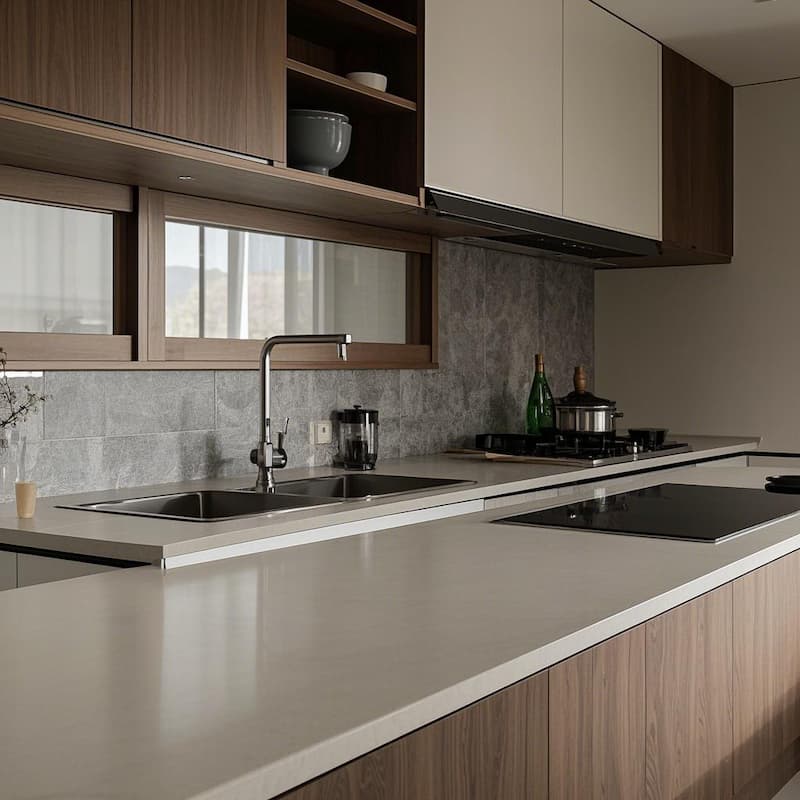
What Is the Difference Between Seamless and Visible Seam Quartz Countertops?
The main difference is the jointing method and the physical characteristics of the surface material. Engineered quartz uses adhesive to connect separate rigid slabs, while acrylic solid surface can be chemically bonded and finished to create a virtually invisible joint.
The following table compares the three common material options available for countertop and interior surface projects.
| Comparison | Pure Acrylic Solid Surface | Composite Acrylic | Engineered Quartz |
|---|---|---|---|
| Seam appearance | Virtually invisible | Very clean, nearly invisible on flat runs | Fine but detectable under close inspection |
| Curved designs | Excellent | Suitable for gentle curves | Limited by rigid slab construction |
| Scratch resistance | Moderate | Moderate | High |
| Repairability | Can be renewed by sanding | Can be renewed by sanding | Deep chips may require resin repair |
| Typical applications | Seamless counters, sinks, curved furniture | Vanity tops and commercial counters | Kitchen islands and high-use countertops |
These differences are also reflected in Kangyi's material selection guidance. For projects that prioritize seamless jointing and curved designs, pure acrylic solid surface may be more suitable. For kitchen countertops requiring a rigid, scratch-resistant surface, engineered quartz is often a more practical choice.
Explore custom seamless solid surface waterfall kitchen islands to see how seamless fabrication can be applied to integrated countertop designs.
What Quartz Seam Measurements Should Fabricators Check?
Seam quality should be evaluated using more than visual appearance alone. Joint width, surface alignment, adhesive compatibility, and structural support all matter.
For reference, Wilsonart's published quartz fabrication manual specifies a maximum seam width of 1/16 inch (1.58 mm), with 1/32 inch (0.79 mm) preferred for improved visual quality. These are product-specific guidelines, not universal tolerances for every quartz manufacturer.
| Inspection item | Reference or target | Why it matters |
|---|---|---|
| Preferred seam width | 1/32 in (0.79 mm) | Helps reduce the visible joint line |
| Published maximum seam width | 1/16 in (1.58 mm) | Wilsonart product-specific guideline |
| Adhesive color | Visually compatible with slab | Reduces color contrast |
| Surface alignment | Flush joint | Prevents noticeable height transitions |
These measurements should always be checked against the specific quartz brand's current technical documentation and the adhesive manufacturer's requirements.
What Are the Most Common Mistakes That Make Quartz Seams Visible?
Even high-quality quartz slabs can produce noticeable joints when fabrication and installation are not properly coordinated. The following mistakes are worth avoiding:
- Mixing different production batches: Slight differences in slab color or pattern can make the joint stand out.
- Ignoring vein direction: Misaligned marble patterns interrupt the visual flow across the countertop.
- Using mismatched adhesive: A contrasting adhesive color creates a visible line between slabs.
- Skipping dry fitting: Unnoticed gaps or alignment problems become more difficult to correct after bonding.
- Improper finishing: Scratches, uneven adhesive removal, or damaged surface gloss can make a seam more obvious.
- Placing seams without considering support: Poorly supported joints may experience stress and potential damage during use.
For fabricators and project buyers, reviewing the cutting layout, actual slab samples, and seam locations before production is usually more effective than trying to correct visible problems after installation.
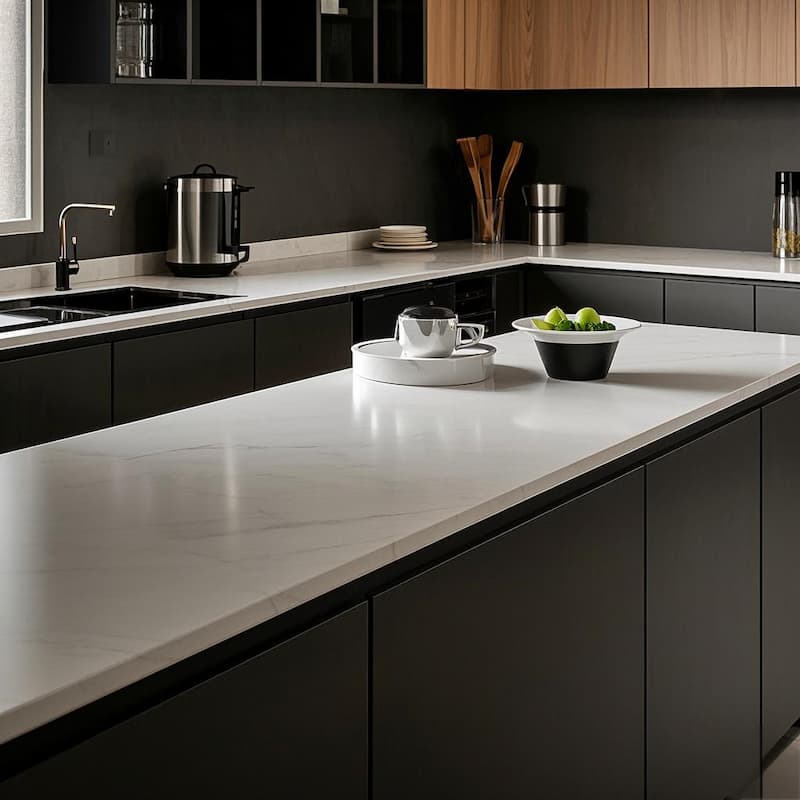
How Can You Choose the Right Quartz Countertop for a Seam-Minimized Design?
Material selection should start with the project's design requirements, slab dimensions, and expected usage. Not every countertop needs the same jointing solution.
For example, a large kitchen island with a marble-inspired pattern may benefit from carefully coordinated slab selection and vein matching. A long reception counter with curved sections may be better suited to acrylic solid surface, where seamless bonding and thermoforming offer more design flexibility.
Kangyi Building, operated by Foshan Kangyi Building Materials Co., Ltd., was established in 2010 and specializes in artificial stone research and development, production, sales, and processing. Its product range includes engineered quartz slabs, acrylic solid surfaces, custom countertops, and other architectural surface products.
For buyers sourcing engineered stone for residential and commercial projects, Kangyi offers quartz countertops and customized solutions based on project dimensions and requirements.
One example is the Calacatta marble-look engineered quartz kitchen countertop, which features marble-inspired veining and supports custom fabrication and vein-matching layouts.
Before placing an order, buyers should confirm the following details with their supplier:
- Slab dimensions, thickness, and available color options.
- Production batch consistency for multi-slab projects.
- Compatibility with the selected adhesive and fabrication process.
- Custom cutting, edge profiles, and CNC processing requirements.
- Seam placement and installation responsibilities.
For wholesale buyers, contractors, and fabricators, these details help reduce installation problems and improve the consistency of the finished project.
FAQ About Quartz Countertop Seams
Will quartz countertop seams be visible?
Yes. Engineered quartz seams are generally detectable under close inspection because separate slabs are joined with adhesive. However, accurate cutting, color-matched adhesive, and proper alignment can make them much less noticeable.
How are quartz slabs joined together?
Quartz slabs are joined using a compatible two-component adhesive or epoxy. Fabricators prepare and clean the edges, match the adhesive color, align the pieces, clamp the joint, and allow it to cure according to the manufacturer's instructions.
Can quartz countertops be made completely seamless?
No. Conventional engineered quartz countertops require joints wherever separate slab sections meet. Pure acrylic solid surface, however, can be chemically bonded and finished to create virtually invisible seams.
What is the best adhesive for quartz countertop seams?
A compatible two-component adhesive or epoxy approved for the specific engineered quartz product is generally used. The adhesive should be pigmented to match the slab, and its curing and application instructions should be followed.
How wide should a quartz countertop seam be?
Seam width depends on the manufacturer's fabrication requirements. For example, Wilsonart recommends 1/32 inch (0.79 mm) as a preferred seam width and specifies 1/16 inch (1.58 mm) as its maximum for the relevant quartz fabrication guidelines. These values should not be treated as universal specifications.
Final Thoughts
Making quartz countertop seams less visible is a combination of material selection, accurate fabrication, adhesive color matching, and proper installation. Although engineered quartz cannot offer truly invisible joints, careful planning can create a clean and visually consistent countertop.
For projects where seamless jointing is the highest priority, acrylic solid surface is worth considering alongside engineered quartz. Choosing the right material at the design stage helps balance appearance, durability, fabrication requirements, and project cost.
Foshan Kangyi Building Materials Co., Ltd. provides engineered quartz and solid surface solutions for customized residential and commercial projects. Contact the Kangyi team to discuss slab options, custom dimensions, and fabrication requirements.